Who is Michele Roberts? Part 2/2

By: Greg Uratsu part 2 of 2…

Last week TWOandTHROUGH wrote about who is Michele Roberts?   This week I’d like to share a great post by Lauren Schwartzberg of fastcompany.com. Lauren does a great job dissecting Roberts’ challenge/goals as the leader of the National basketball Players Associatation (NBPA).  Below is Lauren’s article.  Enjoy!

michele-roberts

Courtesy of: http://www.pbs.org – Judy Woodruff

When Michele Roberts, a white-collar defense attorney, was named the leader of the National Basketball Players Asso­ciation (NBPA) in July, she became the first female executive director of any major men’s professional sports union in the country. It was a significant achievement, but she still faced a daunting challenge: remaking an organization that had fallen into disrepair.

The problem

After years of misman­­age­ment—including some questionable financial dealings on the part of Roberts’s predecessor, Billy Hunter, who also caved on a deal that dramatically reduced members’ collective bargaining power—the players no longer had faith in their union. When Roberts arrived, she was appalled. “It was like a mom-and- pop shop,” she says. “That’s how pathetic this place has been.

The epiphany

To get the job, Roberts had to interview with more than 100 NBA players, and it was while talking to them that she realized the similarities between the 450-member union and the Fortune 500 companies she’d been representing. Just like running a corporation, she says, running a union is about “making deliberate decisions that are going to enhance the value of the entity for its members.”

The execution

To run a good company, you need good people. As soon as she got the job, Roberts set about hiring some to fill the positions of CFO, COO, CTO, general counsel, and head of human resources—none of which had existed under Hunter. “It’s like a startup,” Roberts says. “We needed a management team that could conduct the business of the union.”

The result

The NBPA is completing its first-ever financial audit and rebuilding its relationship with the NBA, as well as with cable companies and others. It will be another two years before the current collective bargaining agreement expires, but Roberts has already taken NBA commissioner Adam Silver to task over what she considers to be unfair caps on players’ salaries. “I would not do what my predecessor has done, and that is ever forget that I work for the union and not the other way around,” she says. “I would never disrespect that relationship.”
 

Who is Michele Roberts? Part 1/2

By: Greg Uratsu

part 1 of 2…

A new NBA collective bargaining agreement is in negotiation right now.  One item to be discussed is the age requirement for the NBA draft.  Adam Silver, the NBA commissioner has said many times he’d like a new age requirement that would transition from “one and done” into the “two and through” era.  In order to get the “two and through” rule in place, the National Basketball Players Association (NBPA) needs to agree to the new rule.  But who’s the head of the NBPA and the voice representing the NBA players?  That person, that voice, that leader is Michele Roberts.

michele-roberts

Courtesy of: http://www.pbs.org – Judy Woodruff

Roberts began her career in 1980 at Public Defender Service for the District of Columbia. She served in that role for eight years, rising to the chief of the trial division. She was mentored by attorney Charles Ogletree.

Roberts was named executive director of the National Basketball Players Association in July 2014. She succeeded Billy Hunter in the position. She received 32 of 36 votes.

“Her background is in negotiation, it’s in changing minds and it’s in listening ability and all of those skills will be very important to the union,” Ogletree said. “People will have a chance to see a woman who is well-prepared, willing to push for what’s right and has the ability to understand what it means for the long haul.”

All those factors are very important for the NBPA, which has struggled since the 2011 lockout and resulting collective bargaining agreement. Former executive director Billy Hunter was fired during All-Star weekend in 2013 after it was discovered he mismanaged union business, and the union has been without a permanent director since.

“The players’ vision of the union is that it belongs to them and it should exist to promote, protect and advance their interest and not any other stakeholder or any other person,” Roberts said. Roberts is an executive director who will not consider any deviation from that vision.

Roberts will have to agree that a “two and through” era will promote, protect and advance the interest for the NBA basketball players in order to bring the rule into effect.

Part 2 of 2 next week…

Don’t Hate the Player, Hate the Game

By: Craig Yamada

Part 2 of 2

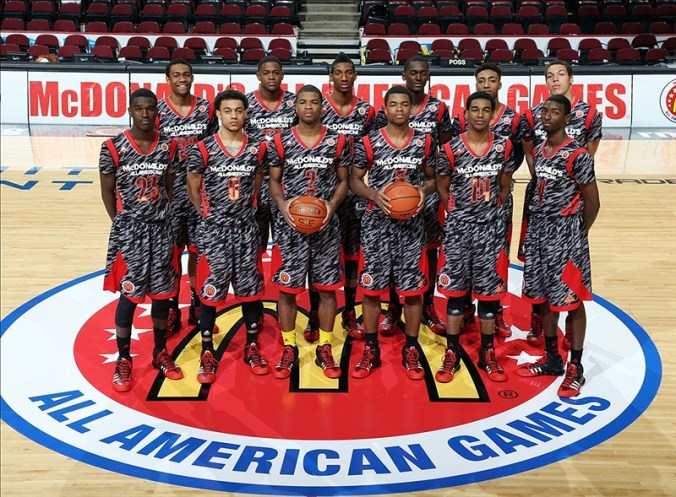
Unless you are a blue blood school like Kentucky, Arizona, Kansas or Duke who are rich in tradition are always overflowing with McDonald’s All-Americans every year. The “reloading” strategy isn’t always plausible for an average school. Coaches are forced to actively recruit to replace a player they will only have for one year thus breaking any foundation they have worked so hard to build in that season. Job security for coaches has always been rough, but with the “one and done” rule in effect, it makes it that much more frail. And we the starving fan base are forced to wave goodbye to our favorite players after just one year of having them represent our alma mater.


Is this selfish of us as a fan group? Absolutely.

But is it fault of the player? Absolutely not.


Players deserve every right to pursue their dreams when they deem fit.  But if they do attend college, there needs to be some kind of educational commitment by that player if they are awarded a scholarship. But that player is also occupying a scholarship that someone else could use who will make earning a degree a priority.


Isn’t the point of college to get some form of education? I used to think it was, but knowing that some of these blue-chip recruits have already made plans to be “one and done” before they even declare for a college, where is the motivation for the student-athlete to attend class or pursue a degree? Likely they just need to pass their classes in order to qualify to participate in basketball activities, unless a coach has strict policies. The college season is so short for some of these potential lottery picks and they often declare for the draft by mid-April. So why force them to be in school for that one year? Let the kids enter the draft out of high school and provide for their families. And then college basketball can focus on players that do want to be in school. Two seasons minimum of college declared athletes will end up benefiting both the college and student-athletes that do want a career post basketball. Much like marriage, college scholarships should be a two-way commitment for both the player and the school alike. The schools can no longer be a “have to” requirement for these kids if they don’t need to be there. I personally think scholarships should be awarded to those athletes who feel like education is a priority for them.  There couldn’t be a better time for the “two and through” era to begin.


Don’t Hate the Player, Hate the Game

By: Craig Yamada

 Part 1 of 2…


College has quickly become merely a pit stop for future NBA draft picks. The “one and done” rule is simply ruining the college game and its coaches and fans are left to pick up the pieces once athletes have moved on to greener pastures.  NBA requirements of a one year wait post high-school has created a scenario where players have two choices after high school graduation:


1)    Attend College for a minimum of 1 year

2)    Play professionally overseas


“Two and Through” Player: Terrence Ross

"Two and Through" Player: Terrence Ross

http://thebiglead.com – Jason McIntyre


The latter is becoming a more popular choice as the years go on. Players who don’t necessarily have the means, but do have the talent are looking to make money overseas as they wait for their turn in the NBA draft the following year. The others who want to play in front of their families and friends, attend college for a year and then quickly leave whether they are ready or not. Those that do leave too early end up spending a long career in the D-League and never make it to the big show and have no degree to fall back on.


The basketball landscape is changing and with it, so must the rules of the game. Players need to have the option to opt for the draft out of high school if they are ready for it. And if they do opt to go to college, two years minimum should be required. “two and through” will soon become the new reality.


To be continued…